On this page
Your bag doesn't know how long your layover is, it just knows what your ticket says. The real question is whether your routing forces you to physically collect it, which comes down to one thing: are you entering the United States, or not.
The short version
- Through-checked, no US entry
- Bag rides invisibly to your final destination; you never touch it
- Through-checked, routing enters the US
- You collect it at first US entry point, clear customs, recheck it, every time, no exceptions (unless the airport has CBP Preclearance)
- CBP Preclearance airports (bag skips the US recheck)
- Dublin, Shannon (Ireland), Abu Dhabi (UAE), Nassau (Bahamas), Aruba, Bermuda, and 10 Canadian airports incl. Toronto, Vancouver, Calgary, Montreal
- Short-checked (separate tickets)
- You collect and recheck it yourself at every stop, US or not
- Storage cost, ballpark
- $2-16/day depending on hub and bag size
- Carry-on strategy
- Pack a full day's kit in your cabin bag if there's any chance you'll leave the airport
Through-checked vs. short-checked
Through-checked means your bag is tagged all the way to your final destination on a single itinerary, and normally you don't see it again until you land for good. This is standard on one-ticket, multi-leg bookings, whether the connection is a 90-minute layover or a 30-hour stopover.
Short-checked happens when you've booked separate tickets (a self-transfer) or when an airline can't check your bag past a certain point (some codeshare or interline limitations). In that case you collect the bag at the connection, walk it through arrivals, and check it in again for the next flight yourself. This is the same self-transfer risk covered on the minimum connection time page: more moving parts, more chances something goes wrong.
When airlines force you to collect your bag anyway
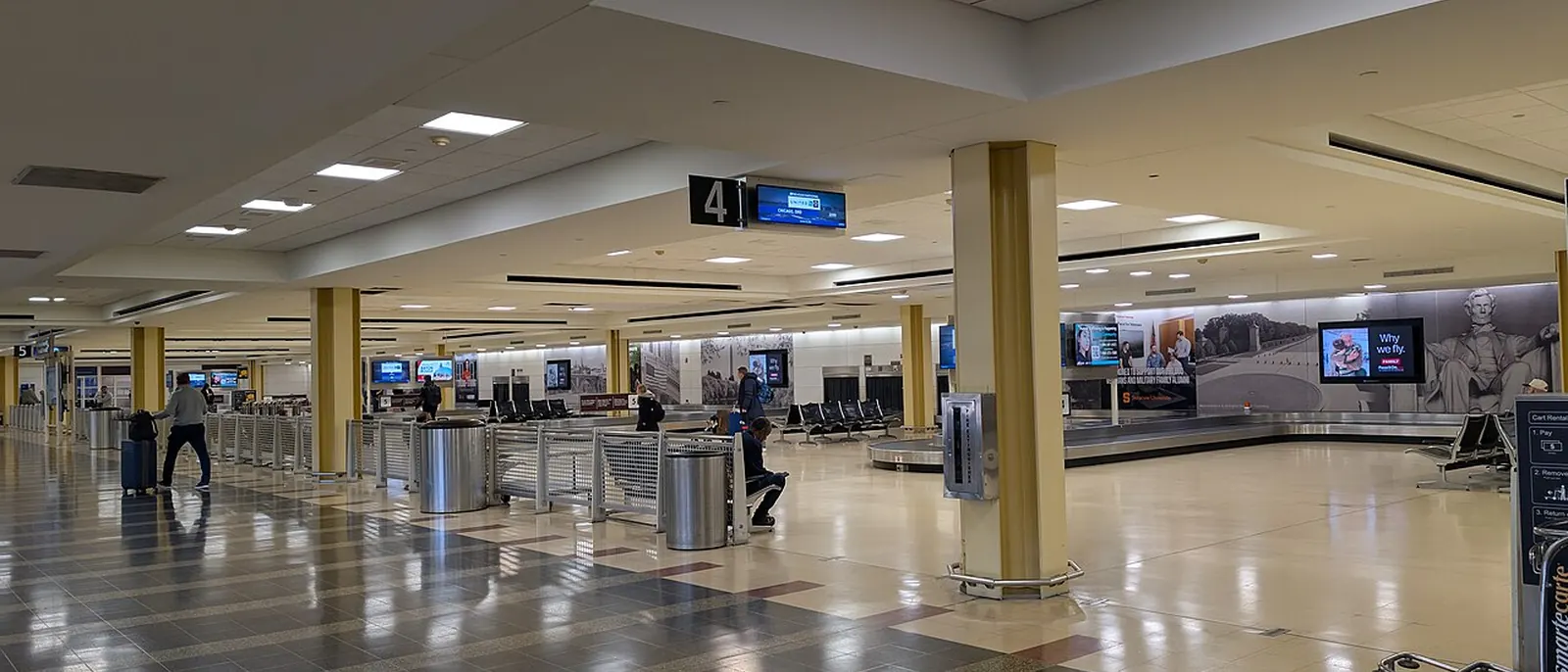
Entering the United States always forces a bag claim, regardless of whether your ticket is through-checked. Here's why: US Customs and Border Protection requires that anyone physically entering the US clear customs with their bags present, then recheck for the next domestic or international leg. Your bag may show as tagged straight through on the label, but you'll still stand at a carousel, grab it, walk it through a customs checkpoint, and hand it off again before your connecting flight.
The exception is CBP Preclearance. At the 16 airports where the US runs a preclearance facility (Dublin, Shannon, Abu Dhabi, Nassau, Aruba, Bermuda, and 10 Canadian airports including Toronto Pearson, Vancouver, Calgary, and Montreal) you clear US customs and immigration before you board, at the foreign airport. Once you land in the US, the connection behaves like a domestic flight: no bag claim, no recheck.
Airport luggage storage: what it actually costs
If your bag isn't through-checked, or you want to drop a carry-on before heading into the city on a stopover, storage runs like this at major hubs (prices are third-party aggregator estimates, confirm current rates before travel):
| Hub | Typical cost | Notes |
|---|---|---|
| Singapore (Changi) | ~SGD 6-16/day depending on bag size | Smarte Carte counters in all 4 terminals, 24/7 |
| Doha (Hamad) | ~QAR 22.50/day and up | Available in the terminal and via third-party counters |
| Dubai (DXB) | ~AED 20 for first 12h, AED 10 per additional 12h | Standard suitcase up to 75cm |
| Tokyo Narita | ~¥500-1,000/day | Coin lockers, size-based; 8-day use limit |
| Tokyo Haneda | ¥300-900/day by size | Size-based per-item pricing |
| Istanbul | ~€8 for 24 hours (per third-party estimate) | Confirm against Istanbul Airport's own counter pricing |
The pattern: coin lockers (Japan) are cheapest and self-serve; staffed counters (Gulf hubs, Singapore) cost more but handle odd-sized or oversized bags and don't have an 8-day cap.
Carry-on strategy for a layover you might leave
Pack your cabin bag like you might not see your checked bag for the whole layover, because on a self-transfer or a US-routing itinerary, you might not want to:
- A change of clothes and basic toiletries, in case your checked bag connects without you needing it, but also in case you want to freshen up before heading into the city.
- Any medication, chargers, and documents you can't replace, always in the cabin bag, never checked, regardless of connection length.
- If you plan to leave the airport on a long layover, keep your daypack light. You do not want to be dragging a full carry-on through immigration lines and city transit for a few hours.
Where people screw this up
- Assuming a through-checked bag means zero interaction with it, even routing through the US. It doesn't. US entry means a mandatory claim-and-recheck, preclearance aside.
- Not knowing their hub has preclearance. Booking a Toronto or Dublin connection to the US without realizing the bag (and the immigration line) is handled before boarding, not after landing, changes how much buffer you actually need.
- Checking a bag on a self-transfer itinerary and not budgeting the reclaim-and-recheck time. This is exactly where separate-ticket connections blow up; see the missed connection page for the buffer math.
- Trusting airport locker "24-hour" pricing without checking the max-stay limit. Japanese coin lockers cap out around 8 days; leave a bag past that and it typically gets moved to a holding office, sometimes with a retrieval fee.
FAQ
Do I need to collect my checked bag during a layover?
Only if your routing enters the US (unless the departure airport has CBP Preclearance) or if you booked separate tickets. Otherwise, a through-checked bag stays with the airline system.
What is CBP Preclearance and does it help my bag?
It's a US Customs and Border Protection facility at select foreign airports (Dublin, Shannon, Abu Dhabi, Nassau, Aruba, Bermuda, and 10 Canadian airports) where you clear US entry before boarding. Your bag skips the claim-and-recheck cycle that non-preclearance US routings require.
How much does airport luggage storage cost?
Roughly $2-16 per day depending on the hub, bag size, and whether it's a coin locker or a staffed counter. Gulf and Singapore hubs run on the higher end; Japanese coin lockers are typically cheapest.
Should I check a bag at all if I have a long layover?
If you're planning to leave the airport and your connection is on separate tickets, or if any leg touches the US without preclearance, keeping everything as carry-on removes an entire category of risk.
Next time, plan this on purpose
A long layover you didn't plan for turns your checked bag into a logistics problem. A long layover you booked on purpose, as a real stopover, means you can plan around the bag: pick a through-checked, single-ticket itinerary, and skip US-routing connections that force a claim-and-recheck. See layover vs. stopover for how that booking decision gets made, or the Qatar Airways Doha stopover for a program built around exactly this kind of planned stop.
Sources
- https://onemileatatime.com/guides/clearing-immigration-us-airport/ (analysis, reputable travel-industry source)
- https://www.afar.com/magazine/why-do-you-have-to-re-check-your-bag-on-connecting-flights
- https://www.cbp.gov/travel/preclearance (official, US Customs and Border Protection)
- https://www.changiairport.com/en/at-changi/facilities-and-services-directory/baggage-storage.html (official)
- https://www.narita-airport.jp/en/service/delivery/locker/ (official)
- https://tokyo-haneda.com/en/service/facilities/baggage_checkroom.html (official)
- https://dohaguides.com/luggage-storage-at-doha-airport/
- https://dxb-airport.com/luggage-storage-pricing-dubai-airport-dxb/